
- Nvidia (NVDA) maintains over 90% market share in AI chips and asserts its Blackwell GPUs remain a full generation ahead of competitors, offering unmatched performance, versatility, and the ability to run every major AI model across all computing environments.
- Despite a 4.53% share drop to $174.28 triggered by reports of Meta (META) potentially adopting Google’s TPUs, Nvidia emphasized it continues to supply Google (GOOG, GOOGL) and highlighted the inherent limitations of single-purpose ASICs compared to its flexible platform.
- Both Nvidia CEO Jensen Huang and Google DeepMind’s Demis Hassabis reaffirmed that AI scaling laws remain intact, ensuring sustained and accelerating demand for Nvidia’s GPUs even as Google advances its in-house TPU technology.
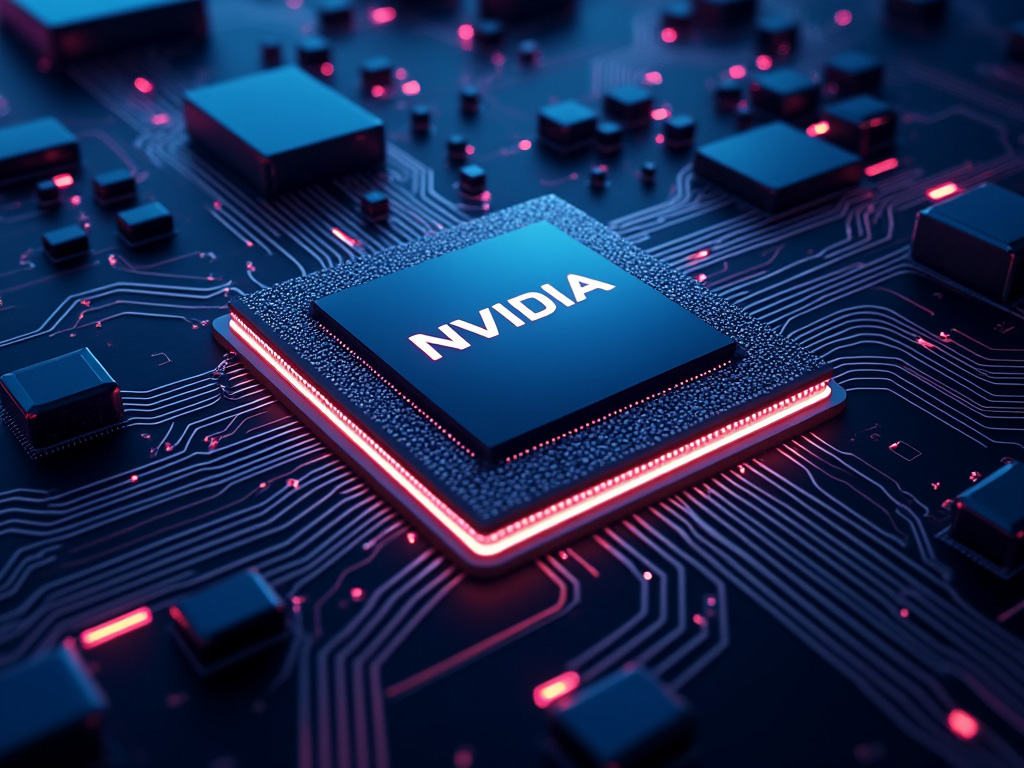
Nvidia (NVDA) continues to assert its commanding position in the artificial intelligence chip market, where it holds more than 90% share according to industry analysts. This dominance stems from the versatility of its graphics processing units, which power the vast majority of AI training and inference workloads globally. The company’s Blackwell architecture represents the latest advancement in this lineage, delivering enhanced performance through integrated compute, memory, and networking optimized for large-scale AI deployments. As hyperscalers and enterprises scale their AI infrastructure, Nvidia’s platform enables seamless execution across diverse models, from foundational training to real-time inference, while maintaining compatibility with every major computing environment.
Recent market dynamics underscore the intensifying scrutiny on Nvidia’s lead, particularly amid reports of potential shifts in customer sourcing strategies. Shares of Nvidia declined 4.53% to $174.28 following disclosures that Meta Platforms (META), a major client, may integrate Google’s (GOOG, GOOGL) tensor processing units into its data centers starting in 2027, with possible rental access via Google Cloud as early as next year. This development highlights broader efforts among AI builders to diversify hardware suppliers, mitigating risks associated with supply constraints and costs tied to Nvidia’s high-demand GPUs. Despite such moves, Nvidia’s ecosystem – bolstered by its CUDA software stack – remains the de facto standard, facilitating rapid deployment and optimization that competitors struggle to replicate at scale.
In direct response to these concerns, Nvidia emphasized the superior attributes of its technology in a recent statement on X. The company positioned its GPUs as a generation ahead of alternatives, underscoring their ability to run every AI model across all computing paradigms. Nvidia explicitly welcomed Google’s progress in AI, noting its ongoing role as a supplier to the search giant, while contrasting the flexibility of its offerings against application-specific integrated circuits like Google’s TPUs. These ASICs, while efficient for targeted internal operations, lack the broad applicability and interoperability that define Nvidia’s approach. “NVIDIA offers greater performance, versatility, and fungibility than ASICs,” the statement affirmed, reinforcing the platform’s edge in handling multifaceted workloads without customization overhead.
Google’s advancements, including the November 2025 release of its seventh-generation Ironwood TPU, have drawn attention for their role in powering sophisticated models like Gemini 3, a state-of-the-art system trained exclusively on TPUs earlier this month. This model excels in benchmarks for mathematics, science, multimodal processing, and agentic reasoning, demonstrating the efficacy of Google’s vertically integrated hardware for in-house innovation. A Google spokesperson affirmed accelerating demand for both its custom TPUs and Nvidia GPUs, signaling a hybrid strategy that leverages Nvidia’s strengths in external flexibility alongside TPU efficiencies for core tasks. Such complementarity benefits the ecosystem, as Google does not commercialize its TPUs but makes them available via cloud rentals, potentially easing adoption for third parties while preserving Nvidia’s direct sales model.
Nvidia’s leadership, including CEO Jensen Huang, has engaged proactively with counterparts at Google to navigate this landscape. During the company’s recent earnings call, Huang highlighted Google as a valued customer, confirming that Gemini models operate effectively on Nvidia hardware. He referenced direct communication with Demis Hassabis, CEO of Google DeepMind, who affirmed the persistence of scaling laws – the principle that larger compute investments yield proportionally greater AI capabilities. This validation aligns with Nvidia’s thesis that escalating model complexity will sustain and amplify demand for its chips and systems, even as alternatives proliferate. Huang’s interactions reflect a collaborative undercurrent in the industry, where shared progress in AI scaling propels collective advancements rather than eroding individual footholds.
Looking ahead, Nvidia’s trajectory remains robust, with Blackwell deployments accelerating across cloud providers and enterprise AI factories. The architecture’s rack-scale integration, including NVLink interconnects and Spectrum-X networking, enables unprecedented efficiency in distributed computing, supporting everything from mixture-of-experts models to reinforcement learning pipelines. As AI infrastructure investments surpass hundreds of billions annually, Nvidia’s unified full-stack design positions it to capture the lion’s share, fostering an environment where innovation outpaces fragmentation. This enduring adaptability ensures that Nvidia not only responds to competitive pressures but continues to define the parameters of AI acceleration.
WallStreetPit does not provide investment advice. All rights reserved.
- Bulenox: Get 45% to 91% OFF ... Use Discount Code: UNO
- Risk Our Money Not Yours | Get 50% to 90% OFF ... Use Discount Code: MMBVBKSM
Disclaimer: This page contains affiliate links. If you choose to make a purchase after clicking a link, we may receive a commission at no additional cost to you. Thank you for your support!


Leave a Reply