
- Rivian (RIVN) unveiled a fully in-house autonomy stack powered by its custom RAP1 chip and Large Driving Model (LDM), shifting away from Nvidia (NVDA) hardware and positioning the company as an AI-native automaker rather than a traditional OEM reliant on third-party suppliers.
- The roadmap targets point-to-point hands-free driving in 2026, followed by eyes-off self-driving and eventual personal Level 4 autonomy, with Universal Hands-Free already expanding to second-gen R1 vehicles across 3.5 million mapped U.S. miles.
- Wall Street reacted strongly, with Needham raising its RIVN price target to $23 from $14 and highlighting that the vertically integrated approach will create cost and iteration advantages, especially when R2 launches in 2027 with eyes-off autonomy at ~$50,000.

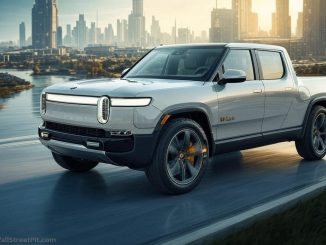
Rivian Automotive Inc. (RIVN) has positioned itself at the forefront of electric vehicle innovation by integrating advanced artificial intelligence into its core platform, a strategic pivot that underscores the company’s commitment to redefining mobility through proprietary technology. This approach not only enhances vehicle performance but also establishes Rivian as a leader in developing end-to-end autonomous systems, distinct from traditional automakers reliant on external suppliers. At the heart of this evolution is the Rivian Autonomy Processor (RAP1), a custom-designed chip that powers the next generation of self-driving capabilities in Rivian electric vehicles. By moving away from third-party components like Nvidia’s Orin chip, Rivian achieves greater control over hardware integration, enabling faster iterations and reduced costs that bolster long-term scalability.
The RAP1 forms the computational backbone for Rivian’s Large Driving Model (LDM), an AI framework trained on vast datasets akin to those used in advanced language processing systems. This model processes real-time inputs to facilitate Universal Hands-Free (UHF) assisted driving, initially expanding to second-generation R1 vehicles across 3.5 million miles of mapped roads in the United States. Such coverage ensures broad applicability for everyday navigation, prioritizing safety and reliability in diverse driving scenarios. Rivian’s data flywheel – where fleet-collected information continuously refines the AI – amplifies this capability, creating a virtuous cycle of improvement that leverages the growing number of vehicles on the road.
Looking ahead, Rivian’s roadmap emphasizes progressive autonomy milestones. In 2026, the company will introduce a point-to-point hands-free system, allowing seamless travel between destinations without manual intervention in supported conditions. This will evolve into hands-free and eyes-free self-driving features, culminating in the pursuit of personal Level 4 autonomy, where vehicles operate independently without requiring driver supervision. These advancements align with industry standards for supervised and unsupervised operation, addressing regulatory and technical hurdles while enhancing user trust through over-the-air updates.
CEO RJ Scaringe, who believes an inflection point in self-driving is approaching, has articulated a foundational shift in Rivian’s engineering philosophy, emphasizing a clean-sheet redesign of the autonomy stack. This includes a revamped camera-based perception system, optimized compute architecture, and an AI-centric design that treats the vehicle fleet as a unified data ecosystem. As Scaringe told YF during Rivian’s Autonomy & AI Day event, this holistic rebuild enables the company to collect and apply real-world data directly to model training, accelerating progress toward unsupervised driving. Such vertical integration not only differentiates Rivian from legacy original equipment manufacturers but also positions it to capture recurring revenue streams through software subscriptions.
Wall Street’s response reflects this potential for competitive differentiation. Needham analyst Chris Pierce highlighted Rivian’s transition from an adopter of off-the-shelf autonomy solutions to a creator of proprietary, AI-driven systems. In his assessment, the in-house silicon and compute platform will foster superior iteration speeds and cost efficiencies, creating barriers against competitors dependent on external vendors. Pierce maintained his ‘Buy’ rating on RIVN while elevating the price target to $23 from $14, implying 24% upside from current levels. This optimism centers on Rivian’s ability to embed advanced features into accessible models, particularly the R2 platform slated for full production in 2027 at approximately $50,000. The R2 will incorporate eyes-off and point-to-point self-driving as standard, making high-level autonomy viable for mainstream consumers and driving adoption in a market increasingly focused on software-enabled vehicles.
Rivian’s strategy intersects with broader trends in electric mobility, where autonomy emerges as a key differentiator amid maturing battery and powertrain technologies. By 2027, as production scales, the integration of RAP1 across the lineup could yield margins exceeding those of hardware alone, mirroring patterns observed in leading EV ecosystems. This focus on software-defined vehicles ensures Rivian not only sustains its adventure-oriented brand but also pioneers sustainable, intelligent transportation solutions that adapt to evolving consumer and regulatory landscapes.
WallStreetPit does not provide investment advice. All rights reserved.
- Bulenox: Get 45% to 91% OFF ... Use Discount Code: UNO
- Risk Our Money Not Yours | Get 50% to 90% OFF ... Use Discount Code: MMBVBKSM
Disclaimer: This page contains affiliate links. If you choose to make a purchase after clicking a link, we may receive a commission at no additional cost to you. Thank you for your support!
Leave a Reply