
- Rivian Automotive (RIVN) has approved a potential $4.6 billion compensation package for CEO RJ Scaringe over 10 years, featuring options for 36.5 million shares vesting upon achieving stock prices from $40 to $140 and operational targets, inspired by Tesla’s (TSLA) model for Elon Musk.
- The package replaces a prior unattainable 2021 grant, doubles Scaringe’s base salary to $2 million, and includes a 10% stake in spinoff Mind Robotics, aligning incentives with $153 billion in projected shareholder value.
- Amid Rivian’s preparations for the 2026 R2 SUV launch to rival Tesla’s Model Y, this structure emphasizes retention and growth in the EV sector, where shares closed at $15.22 against a $14 median target.

Rivian Automotive, Inc. (RIVN) has introduced a compensation structure for CEO RJ Scaringe that could deliver up to $4.6 billion over the next decade, mirroring elements of the landmark package recently ratified for Tesla, Inc. (TSLA) CEO Elon Musk. This arrangement underscores a growing trend among electric vehicle manufacturers to tether executive incentives to ambitious performance metrics, fostering alignment between leadership and long-term shareholder value in a fiercely competitive sector.
At the core of Scaringe’s new plan is a grant of options for up to 36.5 million shares of Rivian’s Class A stock, exercisable at $15.22 per share – about 16 million shares more than his prior allocation. These options vest contingent on Rivian attaining stock price thresholds from $40 to $140 per share within 10 years, alongside operational income and cash flow objectives over the ensuing seven years. Rivian shares closed Friday’s session at $15.22 with a one-year median price target of $14 based on LSEG data, highlighting the stretch nature of these goals. The board’s rationale emphasizes that vesting occurs only upon delivering substantial shareholder value, estimated at $153 billion if all milestones are achieved, per Reuters’ analysis.
This package replaces a 2021 grant tied to a $110 share price target, which Rivian deemed unattainable and subsequently voided. To further bolster retention and focus, the board elevated Scaringe’s base salary to $2 million, informed by an independent consultant’s review aimed at enhancing pay-for-performance linkage. The potential $4.6 billion windfall, inclusive of exercise costs, represents approximately a quarter of Rivian’s $18.7 billion market capitalization and slightly exceeds its $4.4 billion cash reserves as of late September.
Beyond Rivian proper, Scaringe receives 1 million common units in Mind Robotics, a recent spinoff backed by external investors and focused on industrial AI advancements. This stake could yield up to a 10% economic interest once profitability surpasses predefined levels, with Scaringe assuming the chairman role and Rivian retaining an ownership position. Such diversification reflects Rivian’s strategic pivot toward ancillary technologies that could amplify its core operations.
The design draws clear inspiration from Tesla’s model, where shareholders endorsed Musk’s $1 trillion package on Thursday, calibrated against operational and valuation benchmarks spanning a decade. As Yonat Assayag of ClearBridge Compensation Group observes, while not a direct emulation, Rivian’s approach incorporates Musk-like traits in rewarding outsized market expansion. Firms like hers have fielded inquiries for comparable frameworks, signaling broader adoption among growth-oriented companies seeking to motivate founders amid capital-intensive pursuits.
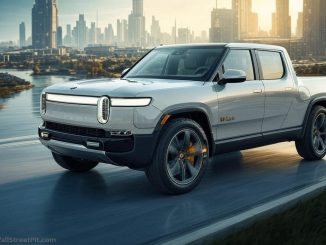
For Rivian, this comes at a pivotal juncture. The company, renowned for its R1S SUVs and R1T pickups, anticipates launching the R2 SUV in 2026 – a compact, cost-effective offering positioned to challenge Tesla’s Model Y in the crossover segment. With production scaling and profitability elusive in the EV landscape, where margins remain pressured by supply chain volatility and subsidy dependencies, such incentives aim to anchor Scaringe’s vision. Rivian’s trajectory, bolstered by early backers like Amazon (AMZN) and Ford (F), hinges on executing these launches while navigating a market projected to exceed 17 million global EV sales annually by decade’s end, per industry forecasts. Yet, the package’s scale invites scrutiny: at roughly 25% of current market value, it amplifies debates on executive remuneration in nascent industries, where failure risks are as pronounced as the rewards. Rivian’s board positions this as a calculated bet on transformative growth, one that could redefine compensation norms if the milestones materialize.
WallStreetPit does not provide investment advice. All rights reserved.
- Bulenox: Get 45% to 91% OFF ... Use Discount Code: UNO
- Risk Our Money Not Yours | Get 50% to 90% OFF ... Use Discount Code: MMBVBKSM
Disclaimer: This page contains affiliate links. If you choose to make a purchase after clicking a link, we may receive a commission at no additional cost to you. Thank you for your support!

Leave a Reply