
- AMD reported Q3 revenue of $9.25 billion and EPS of $1.20, surpassing analyst expectations of $8.74 billion and $1.17, respectively, driven by strong data center growth to $4.3 billion.
- The company guided for Q4 revenue between $9.3 billion and $9.9 billion, exceeding Wall Street’s $9.21 billion forecast, fueled by AI partnerships with OpenAI and Oracle (ORCL) involving up to 6 gigawatts and 50,000 GPUs.
- Despite a 53% 3-month stock surge to a $406 billion market cap, shares dipped more than 4% to $239.62 post-earnings, trailing Nvidia (NVDA)’s dominance, with analysts highlighting rack-scale MI450 deployments as key for future gains.
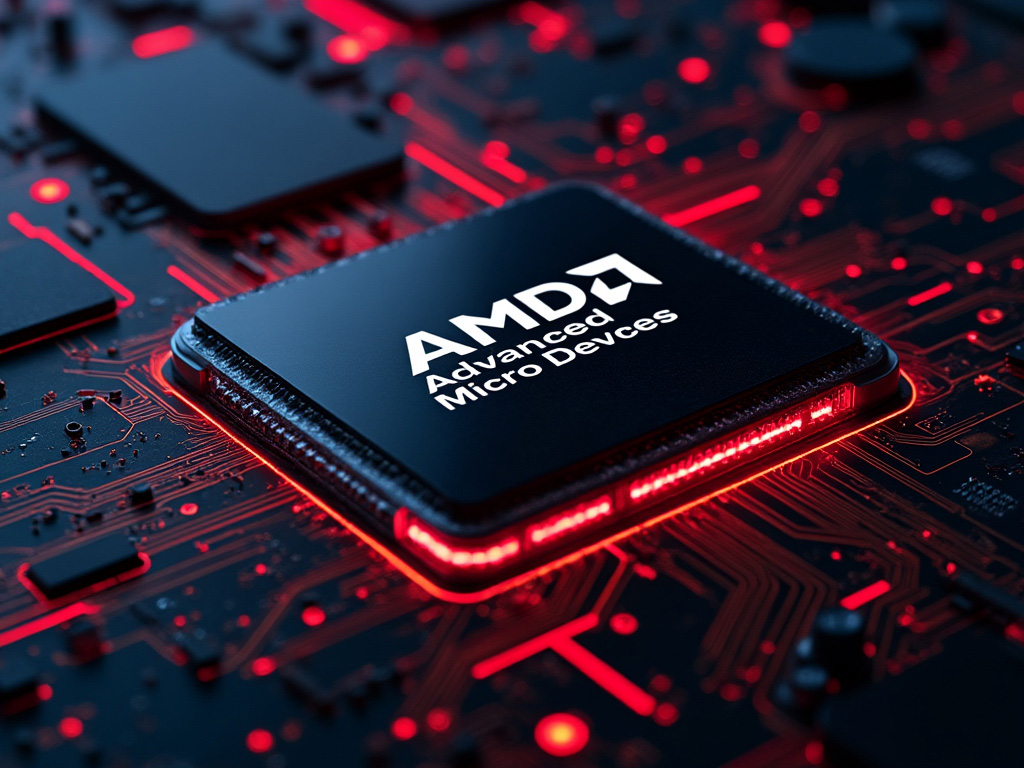
Advanced Micro Devices (AMD) has solidified its position as a formidable contender in the semiconductor landscape with its third-quarter results, underscoring robust demand across its processor and accelerator portfolios. The company achieved earnings per share of $1.20 on revenue of $9.25 billion, surpassing Bloomberg consensus estimates of $1.17 per share and $8.74 billion in sales. This performance reflects the sustained momentum in high-performance computing, particularly in data centers where AMD’s EPYC processors and Instinct AI accelerators are capturing significant market traction.
Central to this quarter’s success was the data center segment, which generated $4.3 billion in revenue, exceeding expectations of $4.1 billion and marking a substantial increase from $3.5 billion in the prior-year period. This growth highlights AMD’s deepening penetration into enterprise and cloud infrastructures, fueled by the proliferation of AI workloads. Complementing this, the client segment – encompassing laptop and desktop chips – delivered $2.9 billion, topping forecasts of $2.6 billion, while the gaming division contributed $1.3 billion, outperforming anticipated $1.1 billion. These figures demonstrate balanced expansion beyond AI-centric revenue, with consumer and gaming markets providing a stable foundation amid cyclical industry pressures.
Looking ahead, AMD’s guidance for the fourth quarter projects revenue between $9.3 billion and $9.9 billion, outpacing Wall Street’s $9.21 billion consensus and signaling accelerated growth. CEO Lisa Su emphasized this trajectory, noting that the company’s expanding compute franchise and scaling data center AI operations are poised to drive substantial revenue and earnings expansion. Such optimism is grounded in strategic partnerships that extend AMD’s reach into hyperscale environments. Recent agreements with OpenAI and Oracle (ORCL) exemplify this, including a commitment to supply up to 6 gigawatts of graphics processing units (GPUs) to OpenAI for its AI data centers, coupled with OpenAI’s purchase of upwards of 160 million AMD shares – representing approximately 10% of the company. Similarly, Oracle will integrate up to 50,000 AMD GPUs across its cloud facilities, enhancing the interoperability of AMD’s solutions in multi-vendor ecosystems.
Further bolstering AMD’s AI infrastructure capabilities is its role in powering two Department of Energy supercomputers at Oak Ridge National Laboratory, backed by a $1 billion public-private investment. These initiatives, alongside deployments of the next-generation MI450 GPUs and rack-scale platforms slated for the second half of 2026, position AMD to address the escalating demands of large-scale computing. Rack-scale offerings, which enable seamless integration of chips into expansive server arrays, are particularly critical for optimizing performance in AI training and inference tasks.
Despite these advancements, AMD’s stock experienced volatility following the earnings release, initially advancing before declining as much as 4% in premarket trading. Over the past 3 months, shares have surged 53%, with year-to-date gains of 107% and a 72% rise over the trailing 12 months, culminating in a market capitalization of $406 billion as of Wednesday morning. This trajectory trails Nvidia (NVDA), the dominant force in AI accelerators with a market cap exceeding $5 trillion, yet AMD’s progress signals a maturing challenge to Nvidia’s hegemony. Analysts, including Morgan Stanley’s (MS) Joseph Moore, view the rack-scale solutions launching next year as pivotal to AMD’s strategy, though uncertainties persist around execution, including reliance on cloud providers for ramping capacity and the need to demonstrate superior return on investment relative to competitors. Ecosystem maturity and rack density remain focal points for customer adoption, as AMD refines its offerings to compete on efficiency and scalability in an increasingly consolidated AI supply chain. Overall, these results affirm AMD’s evolution from a diversified chipmaker to a core enabler of next-generation computing, with its AI momentum poised to reshape industry dynamics.
WallStreetPit does not provide investment advice. All rights reserved.
- Bulenox: Get 45% to 91% OFF ... Use Discount Code: UNO
- Risk Our Money Not Yours | Get 50% to 90% OFF ... Use Discount Code: MMBVBKSM
Disclaimer: This page contains affiliate links. If you choose to make a purchase after clicking a link, we may receive a commission at no additional cost to you. Thank you for your support!

Leave a Reply